
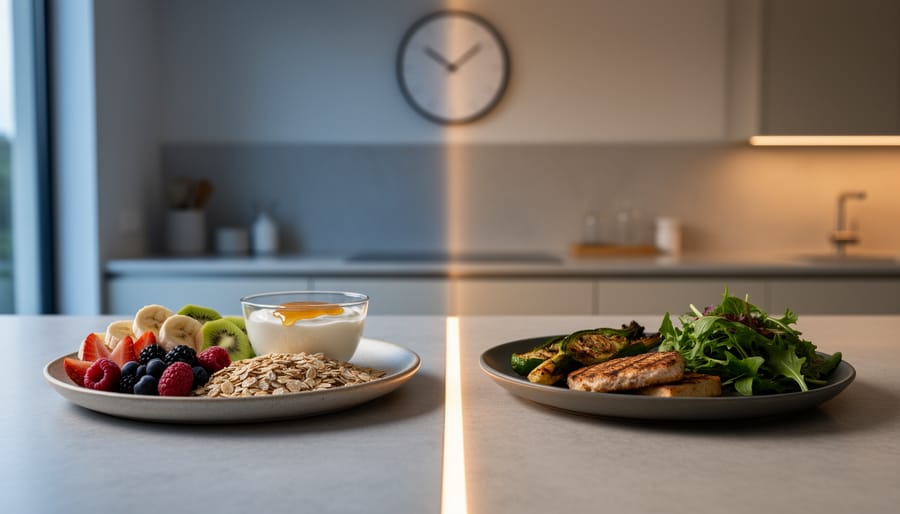
Chrononutrition is the science-based practice of timing your meals and snacks to align with your body’s natural circadian rhythms, the internal 24-hour clock that regulates everything from metabolism and hormone production to digestion and energy use. Rather than focusing solely on what you eat or how much, chrononutrition examines when you eat and how that timing affects your health outcomes.
Research shows that your body processes nutrients differently throughout the day. Eating a large breakfast, for instance, triggers a different metabolic response than consuming the same meal late at night. Your insulin sensitivity peaks in the morning and declines as the day progresses, meaning your body handles carbohydrates more efficiently earlier in the day. Similarly, digestive enzymes, fat storage mechanisms, and hunger hormones all follow predictable daily patterns.
This matters because meal timing that conflicts with your circadian clock can disrupt these natural processes, potentially increasing your risk of weight gain, type 2 diabetes, cardiovascular disease, and poor sleep quality. Canadians who work night shifts, travel across time zones frequently, or simply eat their largest meals late in the evening may be working against their body’s biological programming.
The good news? Chrononutrition offers practical strategies you can implement immediately. By understanding how your internal clock influences metabolism, you can adjust when you eat your meals, how long you fast between dinner and breakfast, and which foods to prioritize at different times of day. This article explains the biological mechanisms behind chrononutrition, outlines the main approaches people use, and provides evidence-based guidance on applying these principles to support your health goals.
What Chrononutrition Means for Your Body

Chrononutrition is the science of aligning when you eat with your body’s internal clock. Rather than focusing solely on calories or nutrients, this approach recognizes that your body processes food differently depending on the time of day. The same meal eaten at breakfast may affect your blood sugar, hormone levels, and energy storage quite differently than if you ate it at dinner.
Your body runs on a roughly 24-hour cycle called a circadian rhythm. This biological clock doesn’t just control when you feel sleepy or alert. It orchestrates hundreds of processes throughout your body, from when your digestive enzymes are most active to when certain hormones peak or drop. Your pancreas becomes more sensitive to insulin in the morning, for instance, while your body temperature and metabolism naturally dip in the late evening.
Understanding a few key terms helps clarify how chrononutrition works:
- Circadian Rhythm
- Your body’s natural 24-hour cycle that regulates sleep, hormone production, body temperature, and metabolism. This internal clock responds primarily to light but also to meal timing.
- Metabolic Window
- The period when your body most efficiently processes nutrients and burns energy. For most people, this window is widest in the morning and narrows as the day progresses.
- Time-Restricted Eating
- An eating pattern that limits food consumption to a specific window each day, typically 8-12 hours. The remaining hours involve fasting, usually overnight.
- Meal Timing
- The strategic scheduling of when you eat throughout the day to match your body’s natural rhythms. This includes not just eating windows, but also the distribution of calories across meals.
Why does timing matter so much? Your liver, muscles, fat tissue, and digestive organs each have their own peripheral clocks. When you eat signals these organs to ramp up certain activities. Eating late at night, when your body expects to be fasting and repairing itself, creates a mismatch. Your insulin response weakens, digestion slows, and your body may store more of those calories as fat rather than burning them for energy.
The practical impact shows up in everyday ways. Eating most of your calories earlier, when your metabolic machinery is primed, can improve how your body handles blood sugar. It may help you sleep better because you’re not digesting a heavy meal when your system wants to rest. Over time, these small daily alignments can influence weight, energy levels, and long-term health outcomes.
How Chrononutrition Works
Your body operates on a sophisticated internal timing system that coordinates when different biological processes happen throughout the 24-hour cycle. At the center of this system sits the suprachiasmatic nucleus, a tiny cluster of about 20,000 neurons in your brain’s hypothalamus that acts as your master clock. This master clock responds primarily to light signals from your eyes, which is why bright morning light helps you feel alert and darkness triggers sleepiness.
But your master clock isn’t working alone. Nearly every organ and tissue in your body contains its own peripheral clock. Your liver, pancreas, stomach, intestines, and even your gut microbiome all have independent circadian rhythms that can be influenced by when you eat. These peripheral clocks coordinate local functions like enzyme production, hormone release, and nutrient processing.
When you eat sends powerful signals to these peripheral clocks, sometimes even overriding signals from the master clock. This creates what researchers call “metabolic timing.” Your pancreas produces insulin most effectively in the morning and early afternoon, which means your body handles carbohydrates better during these hours. By evening, insulin sensitivity drops by roughly 50%, making it harder to process the same meal you could have handled easily at lunchtime.
Similarly, digestive enzymes follow predictable patterns. Your stomach produces more gastric acid and digestive enzymes earlier in the day. Bile production from your liver peaks in the afternoon. Even the speed at which food moves through your digestive tract varies by time of day, generally slowing as evening approaches.
Hormones that regulate hunger and fullness also dance to circadian rhythms. Ghrelin, which stimulates appetite, typically rises before your usual meal times. Leptin, which signals fullness, follows its own daily pattern that can be disrupted by eating at unusual hours. Cortisol, your primary stress hormone, naturally peaks in the morning to help mobilize energy, then gradually decreases throughout the day.
This intricate coordination means that eating a large meal at 8 p.m. triggers a fundamentally different biological response than eating the identical meal at 8 a.m. Your body isn’t just passively receiving food; it’s actively preparing for or recovering from meals based on what time your internal clocks expect them.
Different Approaches to Chrononutrition
Time-Restricted Eating
Time-restricted eating limits your food intake to a specific window each day, typically between 8 and 12 hours. The key principle is that you consume all your meals and snacks within this window, then fast for the remaining hours. Research suggests that eating before 8:30 a.m. may help reduce risk factors for type 2 diabetes, which highlights the importance of starting your eating window early rather than late in the day.
Most people practicing time-restricted eating choose windows like 7 a.m. to 3 p.m. or 8 a.m. to 6 p.m. This approach works with your body’s natural rhythm because insulin sensitivity and metabolic activity are higher in the morning and early afternoon. Your body processes carbohydrates more efficiently when the sun is up, and digestion slows naturally as evening approaches. By finishing meals earlier, you give your digestive system time to rest overnight, which may improve blood sugar control and support better sleep quality.
Meal Timing Patterns
Research shows that front-loading your daily calories, eating a larger breakfast and lunch while keeping dinner lighter, can significantly improve metabolic outcomes compared to the reverse pattern. Studies examining breakfast, lunch, dinner timing found that people who consume most of their calories earlier in the day experience better blood sugar control and improved insulin sensitivity.
This isn’t just about breakfast versus no breakfast. When you eat your first meal matters too. Breaking your overnight fast within two hours of waking helps synchronize your body’s peripheral clocks with your central circadian rhythm. Late breakfast eaters, those who wait until 10 a.m. or later, often show metabolic patterns similar to those who skip the meal entirely.
The traditional “big dinner” pattern common in Canadian households works against your biology. Insulin sensitivity naturally declines as the day progresses, making your body less efficient at processing carbohydrates in the evening. A heavier morning meal supports energy needs when your metabolism is primed, while a lighter dinner aligns with your body’s natural shift toward rest and cellular repair overnight.
Circadian Fasting

Circadian fasting extends the natural overnight fast by avoiding food from early evening through to breakfast. This approach aligns with your body’s circadian rhythm, when metabolic processes naturally slow down as darkness signals rest time.
The typical pattern involves finishing your last meal by 6 or 7 PM and not eating again until morning, creating a 12- to 14-hour fasting window. This timing works with your biology rather than against it. After sunset, insulin sensitivity decreases and your body shifts toward repair mode instead of digestion. Eating late disrupts this process, potentially interfering with sleep quality and overnight cellular maintenance.
Many Canadians already fast naturally during sleep. Circadian fasting simply extends this window by a few hours at either end. The evening cutoff is particularly important because late-night eating has been linked to poorer metabolic outcomes, regardless of total calories consumed.
This pattern can feel more sustainable than aggressive time-restricted eating because it follows natural hunger patterns. Most people find they’re less hungry in the evening once their body adjusts to the routine.
Shift Work Considerations
Working night shifts or rotating schedules disrupts your natural circadian rhythm, making traditional chrononutrition strategies difficult to follow. If you work non-traditional hours, the key is maintaining consistency in your eating pattern relative to your sleep schedule, not the clock.
Plan your main meal during your wake period, typically before or early in your shift when your body is most alert. Avoid heavy meals in the hours before sleep, even if that means eating dinner at 7 a.m. Keep lighter snacks available during work rather than large meals late in your shift. Stay hydrated throughout, but limit caffeine at least four hours before your planned sleep time.
When transitioning between day and night shifts, gradually adjust your eating window over several days rather than switching abruptly. On days off, maintain your work-schedule eating pattern as much as possible to prevent constantly resetting your internal clock, which can worsen metabolic disruption and increase health risks associated with shift work.
How Chrononutrition Is Used in Daily Life

Applying chrononutrition principles doesn’t require a complete lifestyle overhaul. Most Canadians can start by making small adjustments to when they eat, gradually aligning meals with their body’s natural rhythms while still enjoying social connections and family time.
For weight management, the most practical approach involves eating larger meals earlier in the day when insulin sensitivity peaks. This means a substantial breakfast and lunch, with a lighter dinner at least three hours before bed. Many Canadians find this challenging given our cultural tendency toward big evening meals, but even modest shifts, like moving afternoon snacks earlier or reducing dinner portions, can support metabolic health. Planning work lunch ideas that emphasize protein and complex carbohydrates helps sustain energy without triggering late-day cravings.
Blood sugar control improves when we eat during our most metabolically active hours. People managing diabetes or prediabetes often see benefits from eating breakfast within two hours of waking and avoiding late-night snacks. The body processes glucose more efficiently in the morning than at night, which means identical meals eaten at different times produce different blood sugar responses.
Sleep quality responds directly to meal timing. Eating close to bedtime raises body temperature and triggers digestive activity, both of which interfere with sleep onset. Finishing dinner by 7 PM allows for better rest, which in turn supports next-day metabolism. This creates a positive cycle where improved sleep enhances the body’s response to chrononutrition strategies.
For reducing inflammation and immune support extending the overnight fasting period gives the body time for cellular repair processes. A 12-14 hour overnight fast, say, finishing dinner at 7 PM and eating breakfast at 9 AM, supports these maintenance functions without feeling restrictive.
Mental health benefits emerge from the stability that consistent meal timing provides. Regular eating patterns help regulate cortisol and other stress hormones, potentially reducing anxiety and improving mood. The predictability also removes decision fatigue around constant food choices.
Here are practical starting points for most Canadians:
- Eat breakfast within 1-2 hours of waking to jumpstart metabolism
- Front-load protein and calories at breakfast and lunch rather than dinner
- Stop eating 2-3 hours before bed to support sleep and overnight fasting
- Maintain consistent meal times day-to-day, even on weekends
- Adjust timing based on work schedule, night shift workers should eat their main meal before starting work
Implementation looks different for everyone. A parent might serve family dinner at 6 PM instead of 7:30 PM. Someone working shifts could align their eating window with their wake time rather than clock time. Office workers might pack a substantial lunch and lighter dinner, preventing those afternoon energy crashes that often lead to poor evening food choices.
Social eating doesn’t have to derail chrononutrition practices. You can enjoy dinners with friends while choosing smaller portions or eating your main meal at lunch that day. Weekend brunches align perfectly with eating earlier in the day. The goal is progress, not perfection, even partial alignment with your circadian rhythm offers benefits over completely random eating patterns.
Chrononutrition and Health Outcomes: What Research Shows
Studies examining meal timing and circadian alignment reveal meaningful connections to several health outcomes that matter to Canadians. While chrononutrition research is still developing, current evidence suggests that aligning eating patterns with our body’s internal clock may offer tangible benefits beyond simply changing what we eat.
The most robust findings connect meal timing to metabolic health. Research indicates that eating earlier in the day, when insulin sensitivity naturally peaks, helps the body process glucose more efficiently. Studies have found that consuming the same meal at breakfast versus dinner can produce different blood sugar responses, with morning meals typically resulting in better glucose control. For Canadians concerned about diabetes prevention, front-loading calories earlier appears to support more stable blood sugar levels throughout the day.
Cardiovascular health research shows promise but remains preliminary. Some studies link time-restricted eating patterns to improvements in blood pressure and cholesterol markers, though researchers note these benefits may partly stem from overall calorie reduction rather than timing alone. The connection between late-night eating and increased chronic disease risk suggests that avoiding food close to bedtime supports heart health, though more long-term studies are needed.
Weight management studies consistently show that people who eat earlier and limit evening food intake tend to lose more weight than those eating the same calories on a different schedule. This isn’t magic, it likely reflects how our metabolism slows in the evening and how late eating can disrupt sleep, which affects hunger hormones the next day.
Mental health and mood connections are emerging. Research indicates that irregular meal timing and late eating may worsen symptoms of depression and anxiety, while consistent meal schedules aligned with daylight hours support better mood regulation. Sleep quality improves when people finish eating several hours before bed, allowing digestion to complete and melatonin production to proceed uninterrupted.
Cancer risk research remains early-stage. Some studies suggest that longer overnight fasting periods may reduce breast cancer recurrence risk and lower inflammation markers, but these findings need validation through larger, longer trials before drawing firm conclusions.
Common Questions About Chrononutrition
Is skipping breakfast unhealthy?
It depends on your overall eating pattern and when you have your first meal. Research suggests that eating earlier in the day aligns better with natural metabolism, but if you’re practicing time-restricted eating and having a nutritious first meal at 10 or 11 AM, that can still support metabolic health better than eating late into the evening.
What’s the best eating window?
Most research points to an 8-12 hour window starting earlier in the day, such as 8 AM to 6 PM. However, the “best” window varies based on your work schedule, lifestyle, and how your body responds, some people do well with 10 hours, others with 8.
Can I drink coffee during fasting periods?
Yes, black coffee, tea, and water don’t break a fast and can help you stay comfortable during fasting hours. Adding cream, sugar, or milk does provide calories that interrupt the fasted state, so stick with plain beverages if you want to maintain the metabolic benefits of fasting.
How long before I see results?
Many people notice improved energy and better sleep within one to two weeks. Metabolic changes like improved blood sugar control and weight management typically become evident after four to eight weeks of consistent practice.
Is chrononutrition safe for everyone?
While most healthy adults can benefit from aligning meal timing with circadian rhythms, it’s not appropriate for everyone. Pregnant or breastfeeding women, children, people with a history of eating disorders, and those with certain medical conditions should consult a healthcare provider before making significant changes to their eating schedule.
What if my work schedule makes consistent meal timing impossible?
Shift workers and people with irregular schedules can still apply chrononutrition principles by maintaining as much consistency as possible on work days and trying to eat during daylight hours when feasible. Even small adjustments, like avoiding large meals right before sleep, can provide benefits.
One concern many Canadians raise is how chrononutrition fits with social meals and family dinners. The good news is that you don’t need to be rigid about your eating window every single day. Having dinner with friends or family occasionally outside your usual window won’t undo your progress. The goal is consistency most of the time, not perfection. You might aim for following your chosen pattern five or six days a week, allowing flexibility for social occasions.
Individual variation matters significantly with chrononutrition. Some people adapt quickly to earlier eating windows and feel energized, while others need weeks to adjust. Your response depends on factors like your current habits, genetics, stress levels, and overall health. Start with small shifts rather than dramatic changes, moving dinner an hour earlier or extending your overnight fast by 30 minutes, and pay attention to how you feel. If you’re constantly hungry, tired, or struggling to focus, the approach may need adjustment for your body and lifestyle.
Chrononutrition reminds us that the clock matters just as much as the plate. Shifting when you eat, not just what you eat, can influence your metabolism, sleep, weight, and long-term health in meaningful ways.
You don’t need to overhaul your life overnight. Start by noticing your current eating patterns. Do you skip breakfast and eat late dinners? Could you shift your largest meal earlier in the day? Small adjustments, like finishing dinner by 7 p.m. or eating breakfast within an hour of waking, can make a difference.
Talk to your healthcare provider before making significant changes, especially if you have diabetes, take medications, or have a history of disordered eating. Chrononutrition isn’t a one-size-fits-all solution. Your work schedule, family commitments, and health conditions all shape what’s realistic and sustainable for you.
Think of meal timing as one piece of a larger wellness picture that includes sleep, physical activity, stress management, and nutrition quality. The goal isn’t perfection, it’s finding a rhythm that supports your health while fitting into your real life. You have more control over your health than you might think, and small, intentional changes can add up over time.