
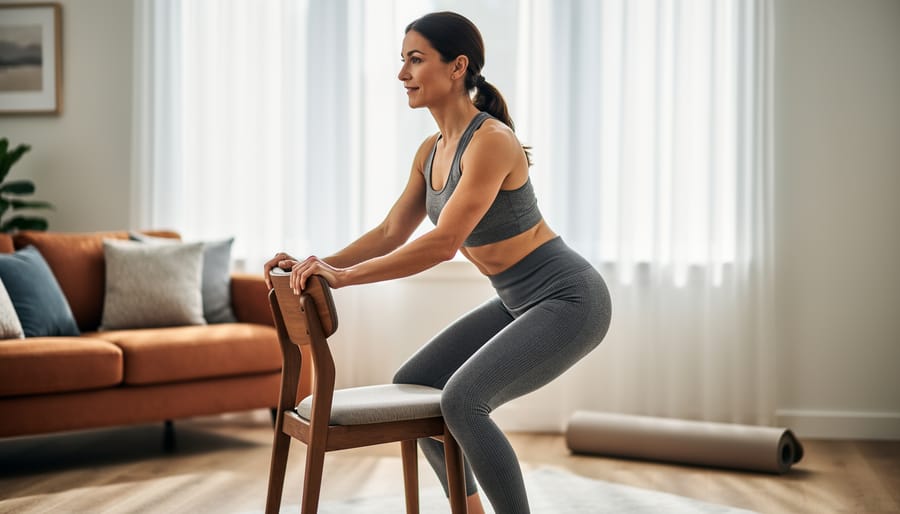
Physical activity reduces osteoarthritis pain more effectively than rest, and you can start safely today even if your joints ache. When you move your joints through controlled exercise, you stimulate the production of synovial fluid, which lubricates cartilage and reduces friction. At the same time, movement strengthens the muscles surrounding affected joints, taking pressure off damaged cartilage and improving stability. Research consistently shows that people with osteoarthritis who engage in regular physical activity experience 25 to 30 percent less pain and significantly better function than those who remain sedentary.
The fear of making OA worse keeps many Canadians on the sidelines, but evidence tells a different story. Appropriate exercise doesn’t accelerate joint damage. In fact, immobility leads to muscle weakness, increased stiffness, and greater pain over time. Your body needs movement to maintain joint health, even when that movement feels counterintuitive.
This guide walks you through safe, progressive exercises designed specifically for osteoarthritis management. You’ll learn which activities protect your joints while building strength, how to distinguish between helpful discomfort and harmful pain, and how to adapt your routine as your condition changes. Whether OA affects your knees, hips, hands, or spine, you’ll find practical strategies backed by current clinical evidence and Reviscon recommendations that fit into your daily life without requiring expensive equipment or gym memberships.
Why Physical Activity Helps Osteoarthritis Pain
When you move a joint affected by osteoarthritis, you trigger several biological processes that directly combat pain. The most immediate benefit comes from muscle strengthening. Strong muscles surrounding your joints act like natural shock absorbers, taking pressure off damaged cartilage and bone. This reduces the grinding sensation and pain many people experience with OA. Even modest strength gains can significantly decrease the load your joints bear during daily activities.
Movement also maintains the health of your cartilage through a process called synovial fluid circulation. Your joints don’t have a direct blood supply, so they rely on movement to pump nutrient-rich fluid in and waste products out. When you’re inactive, this fluid becomes thick and sluggish, leading to the stiffness you feel after sitting too long. Regular activity keeps the fluid flowing, which lubricates your joints and nourishes the remaining cartilage.
Research confirms these benefits. A 2022 study demonstrated that exercise improves knee OA pain and function through enhanced muscle activation and reduced inflammatory markers. The inflammation connection matters because osteoarthritis isn’t just mechanical wear and tear. Low-grade inflammation in and around affected joints amplifies pain signals. Exercise helps control this inflammation while releasing endorphins, your body’s natural painkillers.
Weight management adds another layer of benefit. Every pound of excess weight puts roughly four pounds of pressure on your knees. Losing even five to ten pounds through increased activity can dramatically reduce joint stress. Beyond the physical effects, regular movement improves mental health which influences how you perceive and cope with chronic pain.
What You’ll Need to Get Started
You don’t need a gym membership or expensive equipment to start relieving your osteoarthritis pain through movement. Most effective OA-friendly activities require only basic items you likely already own, and none of it has to break the bank.
Essential items to gather:
- Supportive footwear with cushioned soles and good arch support (running shoes or walking shoes work well)
- Loose, comfortable clothing that allows full range of motion without restricting joints
- A safe walking route in your neighbourhood, local park, or indoor mall during winter months
- Access to water, either a water bottle for hydration or a community pool for aquatic exercise
Helpful but optional additions:
- Resistance bands (light to medium tension) for strength training at home
- A yoga or exercise mat for floor exercises and stretching
- Walking poles to reduce stress on knee and hip joints
- A chair with armrests for seated exercises and support during balance work
- A timer or smartphone to track activity duration
If you have knee or hip osteoarthritis, investing in a second pair of supportive shoes specifically for exercise can help, as worn-out footwear increases joint stress. For hand OA, a set of therapy putty or soft stress balls costs under ten dollars and provides excellent grip strengthening.
Many community centres across Canada offer free or low-cost access to pools and fitness spaces, making it easier to try different activities without upfront costs. The key is starting with what you have and adding equipment only as your routine develops.

Safety First: When to Proceed with Caution
Before you lace up your walking shoes or head to the pool, it’s essential to know when physical activity is safe and when you need professional guidance first. While movement is medicine for osteoarthritis, starting smart protects your joints and prevents setbacks.
When to Talk to Your Healthcare Provider Before Starting
Consult your doctor or physiotherapist before beginning any new exercise routine if you’re experiencing a severe OA flare-up with significant joint swelling and heat, have had joint surgery within the past three months, or have uncontrolled symptoms that interfere with daily activities. Those with additional health conditions like heart disease, uncontrolled diabetes, or balance disorders should also seek clearance first. Your healthcare team can help design an activity plan that works with your current state, not against it.
Understanding Safe vs. Harmful Pain
One of the biggest fears people with OA have is that exercise will damage their joints further. The evidence shows the opposite: appropriate physical activity actually protects cartilage and strengthens the structures supporting your joints. You should expect some mild muscle soreness when starting out, similar to what anyone feels when beginning strength training and a temporary increase in joint awareness during the first few weeks. This typically settles within 15-20 minutes after stopping and shouldn’t prevent your usual activities.
Listen to your body’s signals. Start slowly, increase intensity gradually over weeks rather than days, and respect rest days as part of your routine, not a sign of weakness.
Step-by-Step: Building Your Physical Activity Routine
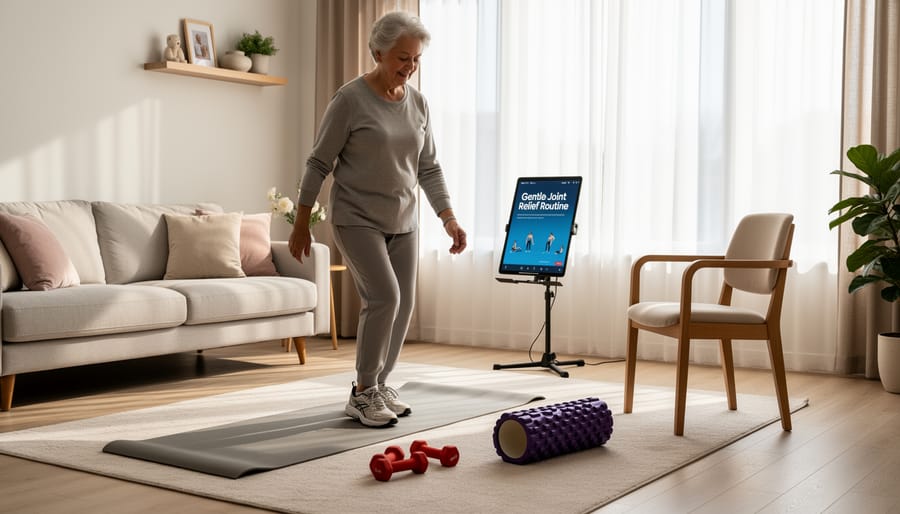
Step 1: Start with Gentle Range-of-Motion Exercises
Range-of-motion exercises form the foundation of any osteoarthritis exercise program because they gently coax stiff joints back into movement without stressing them. These simple flexibility movements work by circulating synovial fluid through your joints, which acts like natural lubrication to reduce that grinding, tight sensation many people experience first thing in the morning.
Start each day with 5-10 minutes of these gentle movements, ideally after a warm shower when your joints feel less rigid. Try ankle circles (10 rotations each direction per foot), slow knee bends while seated or holding a counter for support, shoulder rolls backward and forward, and gentle neck turns. Move only as far as feels comfortable, you should feel a stretch but never sharp pain.
The beauty of range-of-motion exercises is their simplicity. You can do them sitting on the edge of your bed, standing at the kitchen counter, or even during commercial breaks while watching television. Focus on smooth, controlled movements rather than speed or how far you can stretch. These exercises won’t leave you breathless, and that’s exactly the point. They prepare your joints for the day ahead and create a habit of daily movement that becomes automatic within weeks.
Step 2: Add Low-Impact Aerobic Activity
Once you’re comfortable with daily stretches, it’s time to get your heart rate up, gently. Low-impact aerobic activity strengthens your cardiovascular system, lubricates your joints through movement, and helps control weight, all of which ease OA pain without the pounding that high-impact exercise brings.
Walking is the simplest entry point. Start with 10-minute walks three times a week on flat, even surfaces. Pay attention to your footwear, proper cushioning matters. If walking outdoors feels intimidating, try laps around a mall or use a treadmill where you can control the pace.
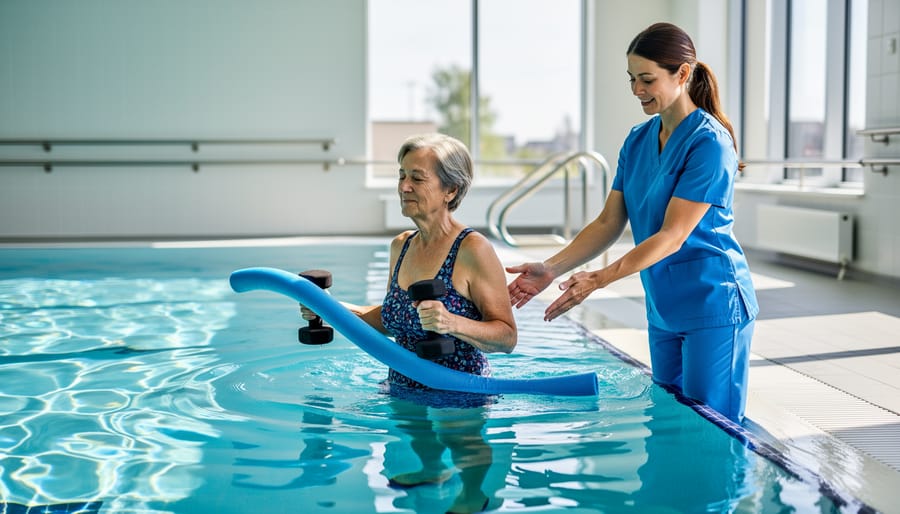
Swimming and water aerobics are ideal if you have moderate to severe knee or hip OA. The buoyancy supports your body weight, reducing joint stress by up to 90 percent while the water’s resistance builds strength. Most community pools offer gentle aquafit classes, and the warm water soothes stiff joints.
Stationary cycling works well for those who need seated support. Adjust the seat height so your knee has a slight bend at the bottom of each pedal stroke. Start with 10 minutes of easy pedaling with minimal resistance.
Gradually add two to three minutes each week as your tolerance improves. Within a month or two, aim for 30 minutes per session.
Step 3: Incorporate Strength Training
Once you’re comfortable with range-of-motion exercises and regular walking or swimming, it’s time to build strength in the muscles that support your affected joints. Strong muscles act like shock absorbers, reducing stress on cartilage and easing pain.
Start with two or three sessions per week, never on consecutive days. Your muscles need rest to adapt. Begin with bodyweight exercises like seated leg lifts for knee OA or wall push-ups for shoulder involvement. If those feel manageable, add resistance bands or light weights (1-2 kg to start).
For knee osteoarthritis, focus on quadriceps exercises, straight leg raises while lying down, or partial mini-squats holding a countertop. Hip and back OA respond well to gentle core work: pelvic tilts, bird-dogs on all fours, or seated torso rotations.
One set of 8-10 repetitions is plenty initially. You should feel mild muscle fatigue, not joint pain. If a particular movement causes sharp discomfort in the joint itself, skip it and try an alternative. Muscle soreness the next day is normal; joint swelling isn’t.
Progress slowly. Add a second set only after two weeks of consistent sessions. Strength gains develop gradually, but within a month most people notice improved stability and reduced pain during daily activities.
Step 4: Practice Balance and Stability Exercises
Balance training might seem like an extra step, but it’s crucial protection for joints already compromised by osteoarthritis. When your balance improves, you reduce the risk of falls that could seriously damage affected joints. You also strengthen the small stabilizer muscles around your hips and knees, taking pressure off damaged cartilage.
Start with simple exercises you can do at home. Stand on one foot while holding a counter for support, working up to 30 seconds per side. Practice heel-to-toe walking along a straight line. Try standing from a chair without using your hands, this builds the stability and strength you need for daily tasks.
Tai chi offers gentle, flowing movements that research shows can significantly reduce falls in people with knee osteoarthritis. The slow, controlled motions improve proprioception, your body’s sense of where it is in space, without stressing your joints. Many community centres across Canada offer beginner classes specifically for older adults or those with arthritis.
Chair yoga provides another low-impact option. You get the balance benefits without the fear of falling, and you can modify every pose to match your comfort level.
Aim for two to three 20-minute sessions weekly. You’ll notice steadier movement within a few weeks, plus the confidence that comes from feeling secure on your feet.
Step 5: Create a Consistent Weekly Schedule
Creating a sustainable weekly schedule is where all the previous steps come together into a routine your joints can rely on. The key is consistency, regular, moderate activity beats sporadic intense sessions every time for OA pain relief.
Aim to spread activities throughout the week rather than cramming them into weekends. A balanced week might look like this: Monday and Thursday for strength training, Tuesday and Friday for aerobic activity like swimming or walking, Wednesday for balance exercises or yoga, and Saturday for a gentle active recovery session like easy stretching or a leisurely walk. Sunday becomes your full rest day.
Rest days aren’t lazy days, they’re essential for joint recovery and muscle repair. Active recovery means light movement that keeps joints mobile without taxing them. Think gentle stretching, casual walking, or recreational activities you enjoy.
Start by scheduling just three sessions weekly, then gradually add more as your body adapts. Mark activities in your calendar like any important appointment. This structure reduces decision fatigue and builds the habit loop that makes physical activity automatic rather than optional.
Adapting Activities for Different Types of Osteoarthritis
Not all osteoarthritis affects the same joints, and your activity plan should reflect where you experience pain and stiffness.
If you have knee osteoarthritis, choose exercises that minimize impact while building strength. Swimming and water aerobics are ideal because water buoyancy reduces pressure on your knees by up to 90%. Cycling on flat terrain or a stationary bike strengthens your quadriceps without jarring your joints. Avoid running, jumping, or activities that require sudden pivoting. Straight-leg raises and seated knee extensions target the muscles that stabilize your knee.
For hip osteoarthritis, focus on activities that keep you upright and moving without excessive weight-bearing strain. Water-based exercise remains your best friend. An elliptical machine provides smooth, controlled motion that builds strength without the impact of walking on hard surfaces. Side-lying leg lifts and clamshell exercises strengthen your hip abductors and reduce pain during daily activities. Skip squats and lunges initially, add them only after building a solid strength foundation.
Hand osteoarthritis responds well to gentle resistance work in warm environments. Squeeze a soft stress ball or therapeutic putty for grip strength. Try finger walks up a wall or gentle fist-opening exercises in a bowl of warm water. Five minutes of hand exercises daily often yields better results than longer, sporadic sessions. You can track progress by noting how many repetitions feel comfortable each week.
If you have spinal osteoarthritis, core strengthening and posture work become priorities. Planks, bird dogs, and pelvic tilts stabilize your spine. Swimming and walking maintain mobility without compression. Yoga and tai chi improve both strength and alignment, but skip poses that hyperextend your back.
Match your activities to your joints, and you’ll find relief faster.
How to Know It’s Working: Tracking Your Progress
When you commit to a physical activity routine for osteoarthritis, you deserve to see your effort paying off. Most people begin noticing meaningful improvements within 4 to 8 weeks of consistent movement, though some changes emerge even sooner. Knowing what to look for, and tracking it in a simple way, helps you stay motivated and gives you concrete evidence that your approach to chronic pain relief is working.
Watch for these measurable signs that physical activity is helping your osteoarthritis:
- Pain intensity decreases during daily activities like climbing stairs or getting out of a chair
- Morning stiffness lasts for a shorter period, perhaps 20 minutes instead of an hour
- Range of motion improves, allowing you to bend, reach, or squat more comfortably
- Sleep quality gets better as nighttime pain and restlessness diminish
- Energy levels increase throughout the day, making routine tasks feel less exhausting
- Dependence on pain medication reduces as movement provides natural relief
A simple tracking method works best. Keep a weekly journal noting your pain level on a 0-to-10 scale, how long morning stiffness lasts, and which activities feel easier than before. You can also perform basic mobility tests monthly, such as timing how long it takes to walk a set distance or counting how many times you can stand from a chair in 30 seconds. These functional measures often reveal progress that daily perception might miss, giving you the encouragement to keep moving forward.
Common Questions About Exercise and Osteoarthritis Pain
Will exercise damage my joints further?
No. Research consistently shows that appropriate physical activity strengthens the muscles around your joints and actually protects cartilage. The key is choosing low-impact activities and respecting pain signals.
What if activity increases my pain?
Some mild muscle soreness is normal when starting a new routine, but sharp or worsening joint pain means you should stop and reassess. If discomfort lasts more than two hours after exercise, you’ve likely pushed too hard and should scale back intensity or duration.
Can I exercise during a flare-up?
During acute flare-ups, focus on gentle range-of-motion exercises only and avoid strength training or aerobic activity until inflammation subsides. Moving the joint gently can actually help, but this isn’t the time to push yourself.
Do I need a physiotherapist to get started?
While not essential for everyone, a physiotherapist can design a personalized program suited to your specific joints and limitations. Many Canadians benefit from even one or two sessions to learn proper form and build confidence.
One question comes up repeatedly: is it ever too late to start exercising with osteoarthritis? The answer is an emphatic no. Studies show that adults in their 70s and 80s who begin appropriate physical activity programs experience meaningful pain reduction and mobility improvements. Your body responds to movement at any age.
As for how much pain is normal, think of it this way: you might feel muscle fatigue or mild joint stiffness that fades within an hour or two. That’s your body adapting. Sharp, stabbing sensations or pain that persists well after you’ve finished isn’t normal and signals you need to adjust your approach. The general guideline is that discomfort during exercise should rate no higher than a 3 or 4 out of 10, and it should improve as you warm up, not worsen.
Many people worry they’ll lose progress if they miss a few days. Life happens, and occasional breaks won’t erase your gains. What matters is getting back to your routine rather than abandoning it entirely. Consistency beats perfection every time.
Next Steps: Resources and Support in Canada
You don’t have to navigate this journey alone. Canada offers extensive support systems to help you safely incorporate physical activity into your osteoarthritis management plan.
Start by booking an assessment with a physiotherapist who specializes in arthritis care. Many provinces provide partial coverage for physiotherapy through provincial health plans or workplace benefits. Your physiotherapist can design a personalized exercise program tailored to your specific joints, mobility level, and goals. They’ll teach you proper form and progression strategies that protect your joints while building strength.
Arthritis Society Canada operates free and low-cost exercise programs across the country, including online options. Their GLA:D (Good Life with osteoArthritis in Denmark) program has been particularly effective, combining education with supervised exercise classes led by trained physiotherapists.
Check your local recreation centres for adaptive fitness programs, aquafit classes, or senior-specific strength training. Many facilities offer reduced rates for older adults and welcome participants with chronic conditions.
Telehealth services have expanded significantly, giving you access to virtual physiotherapy consultations and exercise coaching from home. This option works well if mobility limitations make in-person visits challenging.
Before starting any program, discuss your plans with your family doctor or rheumatologist. They can review your medications, assess your current condition, and connect you with the right resources.
Physical activity stands as one of the most powerful, evidence-backed tools you have for managing osteoarthritis pain. When you approach movement thoughtfully and consistently, you’re not risking further joint damage, you’re actively protecting your joints, strengthening the structures that support them, and helping your body produce its own natural pain relief.
You don’t need to overhaul your entire lifestyle overnight. Start with five minutes of gentle stretching tomorrow morning. Add a short walk next week. Build from there. Small, regular efforts compound into meaningful improvements in how you feel and what you can do.
If you’re uncertain or anxious about starting, reach out to a physiotherapist or your healthcare provider. They can help you design a plan that respects your current abilities and addresses your specific concerns. The Arthritis Society Canada and local community programs offer additional support tailored to Canadians living with OA.
Movement truly is medicine for osteoarthritis. Every step you take, every stretch you complete, every moment you choose activity over inactivity moves you toward less pain and greater independence. You have the power to influence your symptoms, improve your quality of life, and reclaim activities that matter to you. Start where you are, and trust the process.